
PORTSLAYER
Cross-platform CLI + interactive TUI to list and kill processes by port.
Open source · released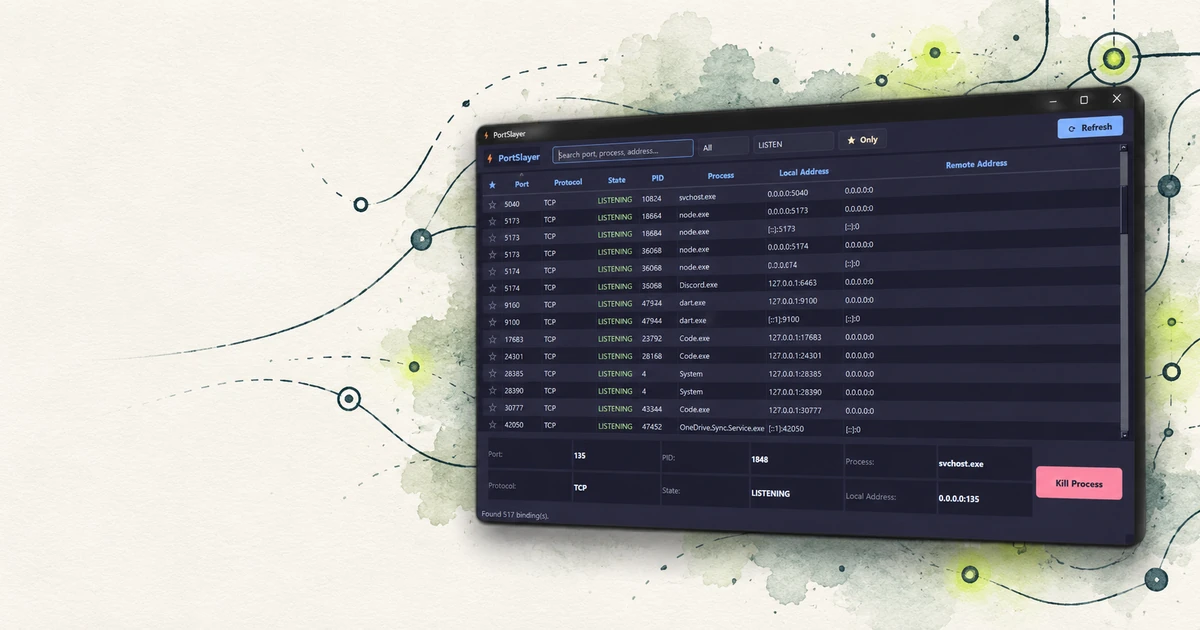
- Fast & Lightweight Performance
- Cross-Platform
- Developer Productivity
- Open Source
Find and kill whatever is squatting on your ports.
Every developer knows the moment: you try to start a dev server and get slapped with Error: address already in use :3000. Somewhere, an old Node process, a zombie Python server, or a forgotten Docker proxy is still holding that port hostage — and normally you'd have to dig through lsof, netstat, or Task Manager just to find out what, let alone kill it safely.
PortSlayer (pk) is a free, open-source CLI and terminal dashboard that finds and kills whatever is squatting on your ports — in seconds. Run pk with no arguments for a full-screen, keyboard-driven dashboard — arrow keys to navigate, / to search, k to kill with confirmation — or script it from the CLI with JSON output. Free and open source under MIT, for Windows and Linux.
It's built for the moments that actually slow developers down: freeing a stuck port before a demo, cleaning up after a crashed test run, or scripting port cleanup into a CI pipeline. Every kill asks for confirmation by default, so you never terminate the wrong process by accident.
Everything you need to manage ports, right from your terminal.
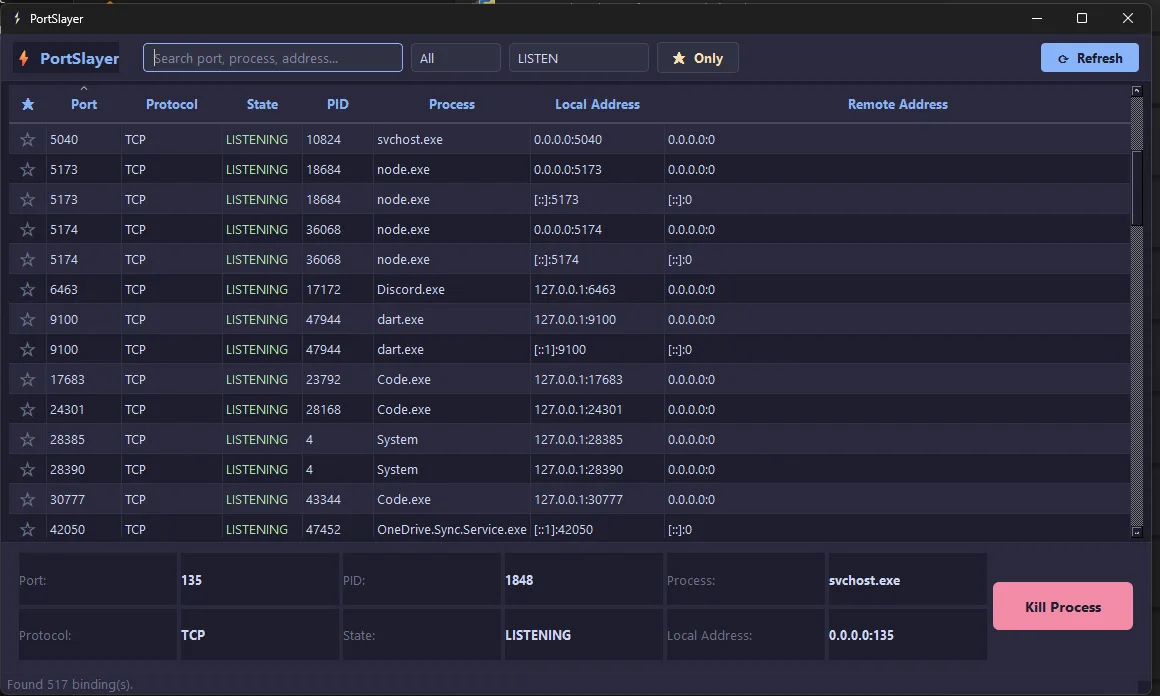
Interactive TUI Dashboard
Run pk with no arguments for a full-screen, keyboard-driven view of every listening port.
Partial port search
Search by port fragment instead of exact numbers.
pk find 808Kill by process name
Skip the port lookup entirely and terminate by process name.
pk kill --name nodeJSON output
Machine-readable output for scripting, CI checks, and automation pipelines.
pk list --jsonShell completion
Tab-complete commands and flags in your shell with a single setup command.
pk --install-completionSafety-first design
Every kill asks for confirmation unless you pass --force, with no shell injection surface.
- 01
List
Run
pkto see every listening port and the process holding it, live. - 02
Find
Search by port fragment or process name —
pk find 808. - 03
Kill
Terminate safely with a confirmation prompt, or skip it with
--force.
A look inside PortSlayer.
 01
Interactive TUI DashboardLive port and process management 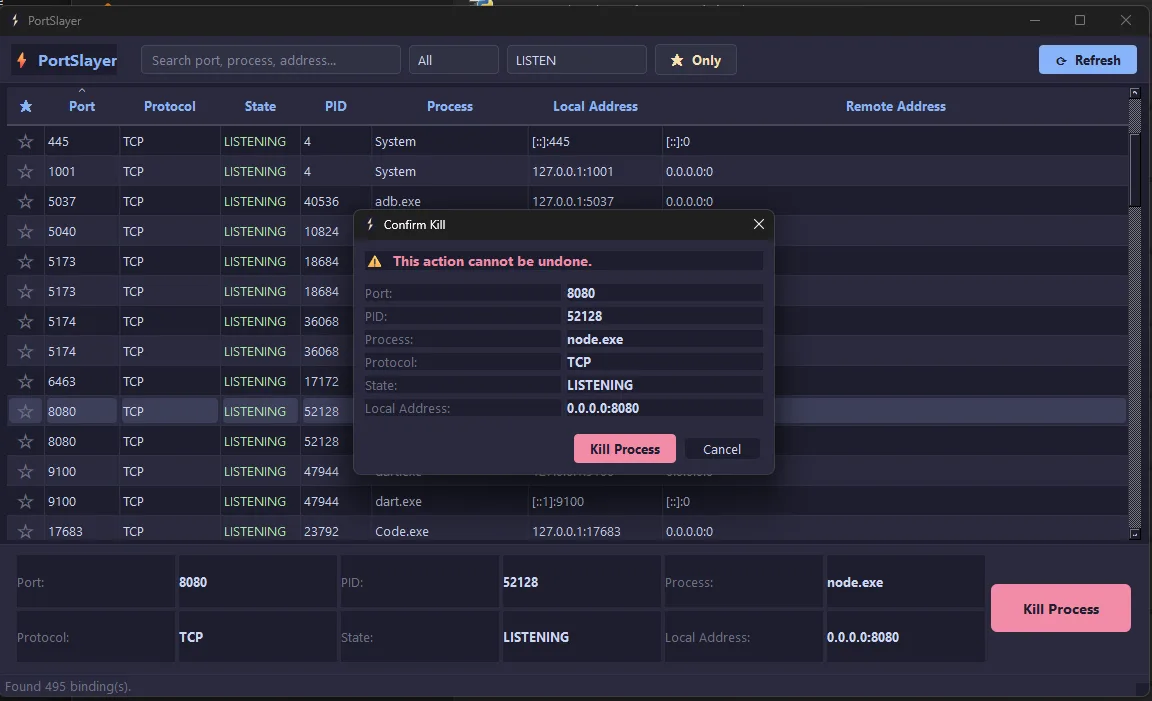 02
Safe Kill ConfirmationReview process details before action
Own it. Fork it. Ship it.
PortSlayer is free and open source under the MIT license. Install it from PyPI in seconds.
pip install portslayerpip install --upgrade portslayer